Meeting your Challenges
As one of the most important contributors to the Democratic Republic of Congo’s Economy, it is important to ensure that mining practices are cognizant to the social and environmental dimensions of water and its profound impact in creating sustainable and environmentally friendly practices, reducing a mines Carbon footprint, as well as properly filtering and recycling water at mining sites as part of the bigger picture.
Water is life or death for people and mining projects. There is increased awareness in the mining industry, where it has been recognised that water management is more than a technical and economic challenge. Mining companies face growing water risks related to operations, regulations, reputation, and investor expectations and several mining companies in the DRC have had operations shut down because of avoidable community led protests, many centered on water issues
The poor quality mining wastewater that often results from mining is of great concern, and must be handled with care. Mining companies are facing increasing environmental pressure from communities, and tougher legislation from local governments. To respond to these requirements, a great number of mining companies have developed comprehensive water management plans, however, It is vitally important to make optimal use of water as well as treat wastewater using renewable energies.
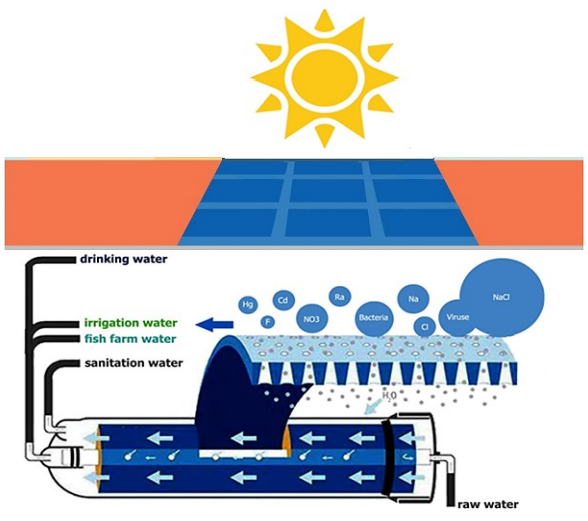
The robust solar-powered outdoor water treatment system is able to produce drinking and irrigation water directly from recycled water onsite and make optimal use of water as well as treat wastewater using renewable energies. The Water kiosks is based on a modified reverse osmosis (RO) system and is able to produce 4 types of water quality: drinking water, irrigation water, fish farm water and sanitation water.
The kiosks can produce between 5,000 to 20,000 L/day, serving up to 5,000 people.
The Technology - German Solar Powered Water Filtration
Raw water is treated to become drinking water using solar-powered reverse osmosis. Raw water is pushed through the semipermeable membrane walls, and substances and impurities that are dissolved in the water are removed.
The technology is scalable from 1,000 Litres per hour to 20,000 Liters per hour of hygienic drinking water from saline or bacterially contaminated water resources.
The installation is also equipped with charging capabilities for gadgets ranging from mobile phones to electric cargo bikes.